Games deserve better production.
Set goals around what players should experience, and see how close the work really is.
See at every milestone whether the game is on time and whether it's worth playing.
See how it worksOn time, and worth playing
A game can hit every milestone and still not be worth playing. So every milestone in SilkRaven shows two lights: Readiness, whether the work has reached the quality it needs, and the Game light, where the creative director rates the game itself, always with a reason.

How it works
In a study of 200 game postmortems from 1997 to 2019, management and production together caused more problems than technology or design. Source: Politowski et al., Game industry problems (2021) (opens in a new tab)
Plan around experiences
Set a milestone's goals around the experiences players should get, with checks that show whether you got there.
See what isn't ready, while there's time
Each milestone lists the work still below the stage it needs, in every discipline, and who can sign it off.
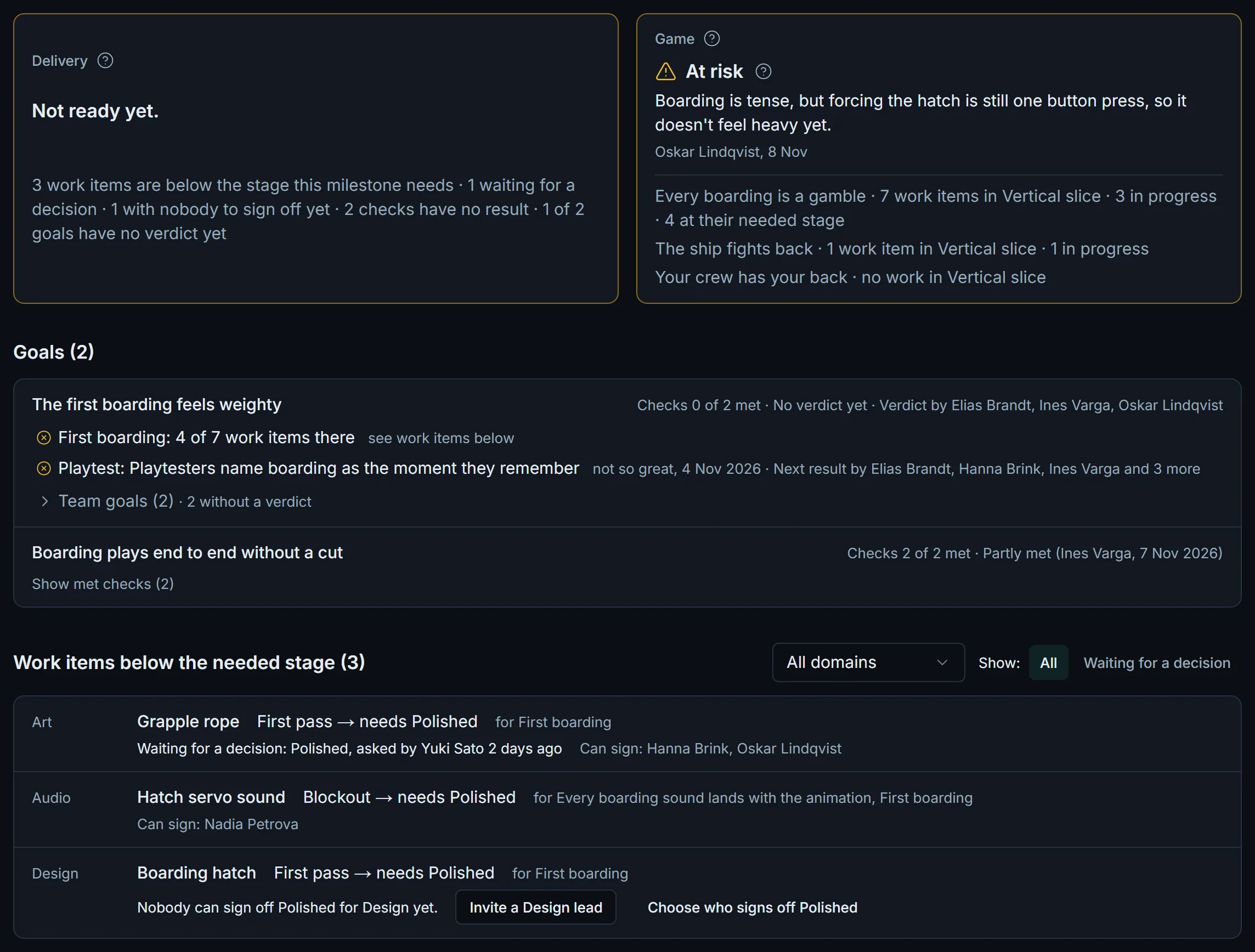
Three work items are below Polished three weeks out, and nobody can sign the hatch off for Design yet. Keep the scope honest
Give each work item a priority for the milestone: Must, Should or Bonus. When something runs late, the Shoulds and Bonuses are what you drop to keep the Musts on track, so SilkRaven warns you early when a milestone is mostly Musts and has little you could drop. Every change to the plan keeps its reason.
Done means done
Work moves through quality stages you define, and the right lead signs off each one, so a finished item has met the standard you agreed.
Ready for any review
One page shows what you promised, what you delivered and the reason for every change in between. You can walk into a review with your publisher or your own team prepared, and make the status report from the same page.

Who's behind it
Built by a AAA producer with 15 years in production and delivery, who's seen games slip when no one was sure what was finished, and core loops that still weren't fun years into development.
How we work
SilkRaven never ranks or measures individuals, so there are no leaderboards and no time tracking.
Questions
What does SilkRaven replace, and what does it work with?
It replaces your production tracking: the plan, the tasks and estimates, the bug list, the status deck and the round of “is it done?” messages to every lead. A small team can review art in it too: the capture goes on the work item, where the team comments on it and the art lead signs the stage off. Each game also has its own pages, so the same team can keep its art direction and design notes in SilkRaven instead of a separate wiki.
Bigger teams usually keep their review tool for drawing over frames and comparing versions, and their wiki for long documents; SilkRaven links to both, and a file or link from any tool can go on a work item as evidence. It reads commits from GitHub and shows them on the work item they name, while the game itself is still built in your engine and version control. See where SilkRaven fits.
Can we bring our plan in from another tool?
Yes. If your current tool or spreadsheet can export a CSV or Excel file, you can bring in work items, tasks and bugs from it, up to 5,000 rows at a time.
Can we track bugs in it?
Yes. Anyone on the game can report a bug and link it to the work item it affects. Your game can have QA confirm new bugs and check each fix; while nobody is marked as QA, producers and the leads and directors for that discipline can do both. When someone signs off a stage, they see the work item's open bugs by severity, and the decision is still theirs.
Does it track individual people?
No. There are no leaderboards, no productivity scores and no logging of hours. Work is estimated in days, and when it grows or shrinks you see it on the work item, the team and the milestone, never per person.
Does it use AI?
Not at launch. SilkRaven has no AI features and sends none of your studio's data to an AI service. We plan to add suggestions built from your own game's data, such as estimates based on how long similar work really took, or help turning a rough goal into one your team can check. They'll be off until your studio turns them on and will never make art or other game assets; they'll only suggest, with their reasons shown, and a person always decides.
What does it cost?
€10 a month for each editor, meaning anyone who can change things on a game. Viewers and people who only handle billing are free. Your studio gets 30 days free, then pays half for its first 4 paid months if it has 30 editors or fewer.
How much room do we get for files?
Each game includes 250 GB of stored files and 20 GB of downloads a month for each editor, up to 4 TB a game. Going over never costs extra; if a game goes well over, we pause uploads or file opening until you add storage or downloads to it, or delete files. See pricing.
Can we get our data out?
Yes. Your studio can ask us for an export of its games at any time.
Where is our data kept?
In the EU, in Ireland. Security and data has the details.
Games deserve better production, and so do the people who make them.
Help shape SilkRaven
We're looking for studios to try it early and tell us what works for them. Signing up takes about a minute.